Measure the furniture in the form you will move it
Before choosing a sofa, cabinet or dining table, write down its width, depth and height. Use the widest points, including arms, handles, feet and any projecting trim. A product’s listed dimensions are a good starting point, but confirm what they include if the measurements are close to your available space.
Find out whether the piece arrives assembled or in boxes. Boxed dimensions matter for delivery; assembled dimensions matter if you may move the piece later. Check whether legs, cushions, shelves or a tabletop can be removed, and whether removal is straightforward. Do not assume an upholstered back or fixed frame can be taken apart.
For an existing piece, measure it yourself with a rigid tape measure and record the numbers in the same order every time: width, depth, height. Photographing the piece alongside your notes can help you remember which side has a protruding detail.
Follow the entire route, not just the front door
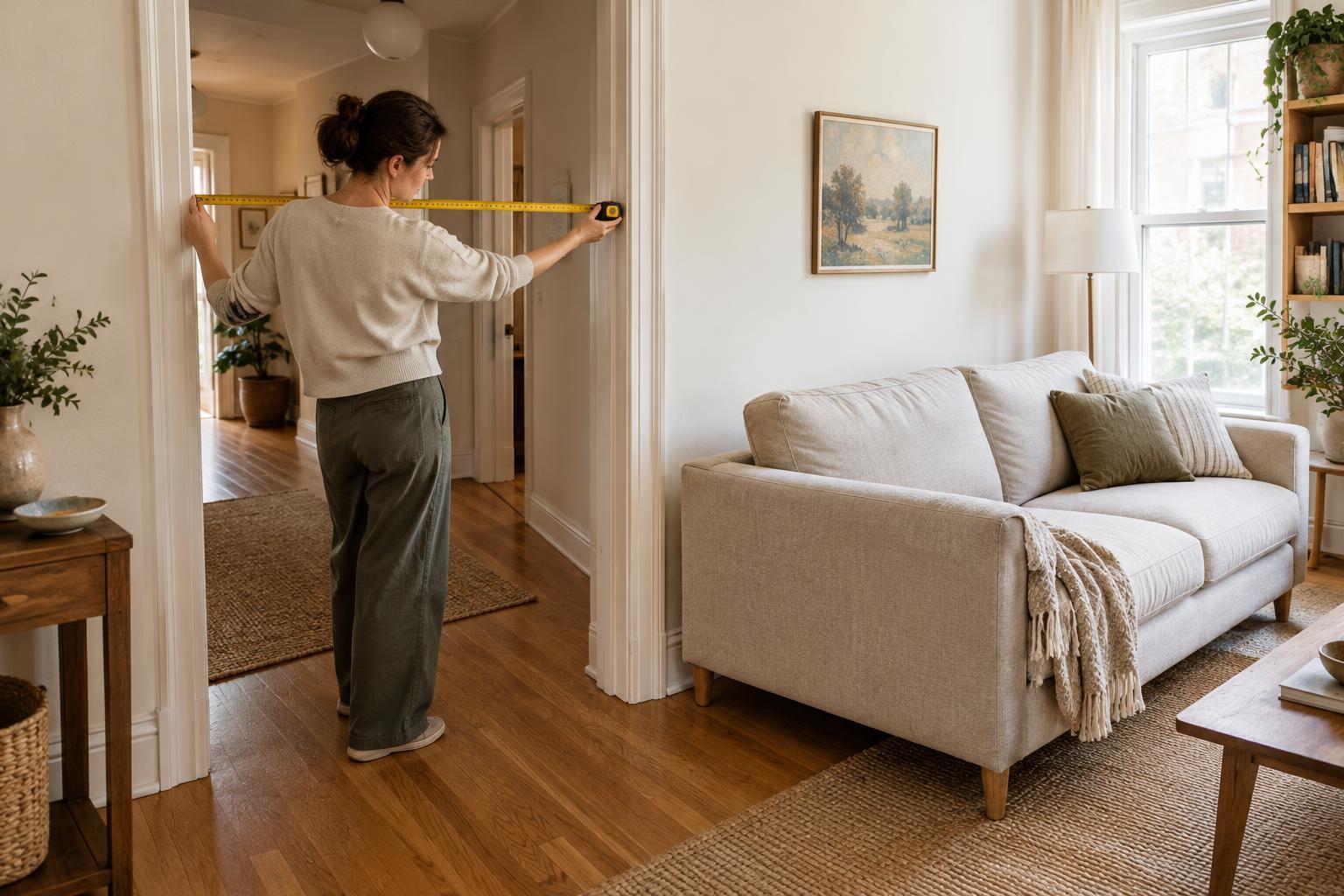
Walk the route from the delivery entrance to the furniture’s intended position. Measure the clear opening of each doorway: the usable space between the doorstop or frame edges when the door is open. A door leaf, handle or closer may reduce that opening, so measure the space available in its actual open position.
Next, check hallways, landings, staircases and any elevator. Record the narrowest width and the lowest ceiling or overhead obstruction along the route. Look for radiators, handrails, light fixtures and sharp corners. At a turn, the question is not only whether the furniture fits through each straight stretch, but whether there is room to rotate it between them.
Allow a little margin rather than planning a move that works only if every measurement is exact. Protective wrapping and the hands needed to guide a heavy piece take up space. If an opening is especially close to the furniture’s dimensions, ask the seller or delivery team to assess the route before committing.
Think through the angles carefully
A piece may pass through a doorway on its side even when it will not pass upright. Compare each furniture dimension with the doorway’s clear width and height, then consider which orientation can be maintained before and after the opening. For a long sofa, check whether there is space on both sides of the door to bring its length around.
Tilting can help in some situations, but a promising diagonal measurement does not guarantee a fit. The furniture has thickness, and its corners must clear the frame throughout the movement. Tight stair turns and short landings make this particularly important. If you cannot picture a continuous path for the whole piece, treat the route as uncertain rather than assuming movers can angle it through.
Map the fit inside the room
Once the delivery route checks out, measure the room itself. Note wall lengths, window positions, door swings, vents, outlets and any features you want to keep accessible. Mark the proposed furniture footprint on the floor with painter’s tape, or cut a paper template for a smaller item. This makes the scale easier to judge than dimensions on a screen.
Walk around the taped area as you would on an ordinary day. Can you pass between the sofa and coffee table? Pull out a dining chair? Open a cabinet door fully? A piece can technically fit while making the room awkward to use. Leave space for movement and for the other objects that make the room feel welcoming, such as a lamp or side table.
Make one final check before delivery
Keep a short measurement list that separates furniture dimensions, packaged dimensions, route clearances and the planned floor footprint. Compare like with like, and recheck any number that leaves little room to spare. If a door can be removed from its hinges, confirm who would do that and whether it is permitted; do not build the plan around an unconfirmed adjustment.
When the route or fit remains doubtful, a piece that ships in manageable sections may be the simpler choice. Measuring first does more than prevent a difficult delivery: it helps you choose furniture that feels at ease in the room and leaves space for everyday life around it.